
Self-Employed or Company: Which Is Better in Spain?
When you are thinking about starting a business in Spain, one of the most common doubts is whether it is better to be self-employed (autónomo) or to set up a Limited Company (Sociedad Limitada – SL). The answer depends on several key factors that you must take into account and that we at Gabinete Law summarise in 5 points.
- Liability
- Taxation
- Administrative Procedures
- Costs
- Financing and professionalism
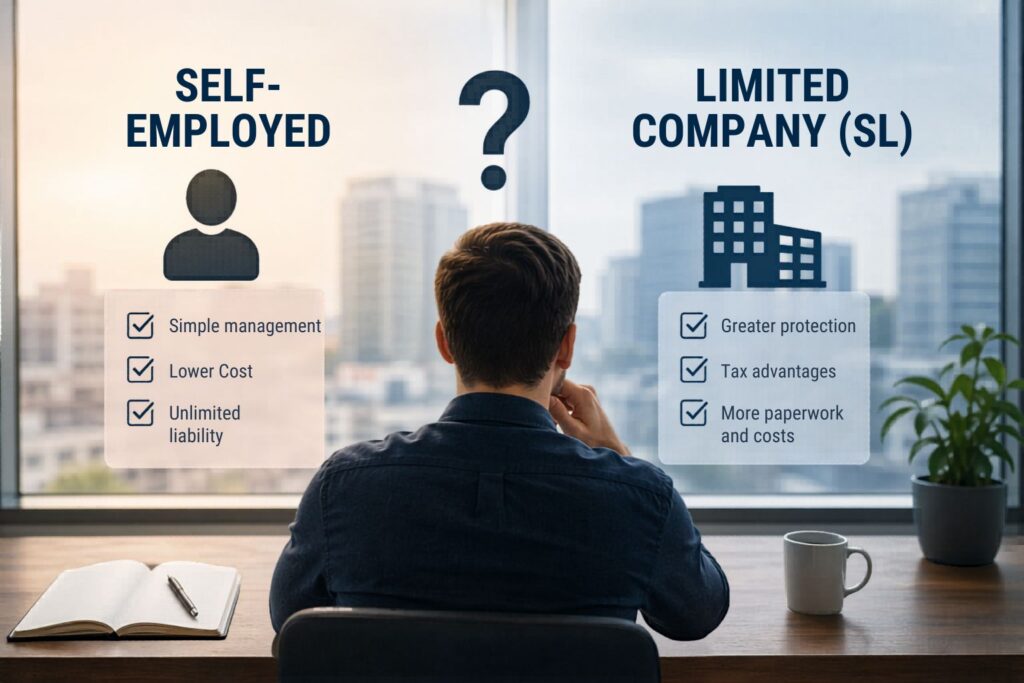
What should I choose: be self-employed or set up an SL (Spanish LLC)?
As we have mentioned, we will go point by point analysing the reasons for choosing between registering as self-employed or incorporating a company (an SL/Spanish LLC).
1. Liability: differences between self-employed and Limited Company (SL)
First, liability. As a self-employed person, you are liable with all your personal assets for any problem, whereas in an SL your liability is limited to the capital contributed, which protects you a little more.
This means that, if you have debts or any legal conflict arises in your activity as a self-employed person, there is no separation between your personal assets and those of the business. In contrast, in a Limited Company (SL), the company is an independent legal entity, which creates a barrier between your personal assets and business risks.
In other words, there is no separation between you and your business if you are self-employed. If you have debts or legal problems, you are liable with everything: savings, car and even your home if necessary.
In contrast, in an SL, you are only liable for the capital you have contributed. For example, if you have 3,000 shares of €1 each, your liability is limited to those €3,000, not to your personal assets.
Consequently, it is essential to analyse the type of activity of your business to protect your liability and your personal finances.
2. Taxation: who pays more taxes, a self-employed person or a company?
Regarding taxation, self-employed people usually pay taxes on their personal income through IRPF (Personal Income Tax), which is progressive, meaning the more you earn, the higher the percentage you pay. Currently in Spain, IRPF rates range approximately from 19% to 47%, depending on the autonomous community and the income bracket.
On the other hand, the SL Company is taxed as a company through Corporate Tax (Impuesto de Sociedades), which is normally a fixed rate of 25% on profits. This can offer tax advantages especially if your income is high, as it allows you to better plan how to withdraw money as a salary or dividends, reducing the tax burden compared to being self-employed.
3. Administrative procedures: is it easier to register as self-employed or to set up an SL?
Administrative procedures also make a difference: being self-employed is simpler and quicker to start; setting up an SL requires more paperwork and time to formalise it.
As a self-employed person, the procedures are simple: you only need to register with the AEAT (Tax Agency) and the TGSS (General Treasury of Social Security). This allows you to start invoicing quickly, with minimal costs and bureaucracy.
In contrast, setting up an SL Company in Spain requires several additional steps that involve more time and costs:
- Requesting the company name (denominación social) to ensure the company name is not registered.
- Drafting the company bylaws (estatutos sociales).
- Going to the notary to formalise the deed of incorporation (escritura de constitución).
- Registering the company in the Commercial Registry (Registro Mercantil).
- Furthermore, you must register with the AEAT and, most likely, with the TGSS as a self-employed company director (autónomo societario) at least one partner.
In this case it is clear, it is much quicker and simpler to register as self-employed than to incorporate a Limited Company.
4. Costs: what is more expensive, registering as self-employed or creating a company?
We cannot forget the initial and recurring costs when deciding between being self-employed or creating an SL.
As a self-employed person, the initial costs are low: you only need to register with the Tax Administration (AEAT) and the Social Security (TGSS), and there are no notary or registration fees. The main recurring cost is the accountancy/administration (gestoría), which usually charges according to your business volume, number of transactions and complexity of the accounting.
In an SL, the initial costs are higher: you have to pay notary fees, commercial registry fees, a lawyer for the incorporation and drafting of bylaws, and contribute the corresponding share capital (capital social). Furthermore, the recurring accountancy fee is usually more expensive than for a self-employed person, as in addition to the usual tax obligations, it must prepare annual accounts, official books and other mandatory accounting reports for the company.
Again, registering as self-employed is much cheaper than creating a company.
5. Financing and professionalism: can you get a loan as a self-employed person?
Finally, it is important to consider the financing and professionalism of your business. Many companies and clients often prefer to work with limited companies due to the legal separation of assets and the fiscal clarity that an SL offers.
Regarding financing, accessing credit or loans is usually easier for a Spanish Company, SL. Banks and financial institutions value the stability and legal structure of the company, and they also usually require business plans and annual accounts, something the SL already has on a mandatory basis.
However, in newly created companies, this advantage does not change much, as the partners are usually forced to sign as guarantors, which means they are personally liable in case of default.
In the long term, when the company has been operating for several years and has a good financial track record, the Spanish LLC (SL) offers greater security and confidence for obtaining financing without compromising personal assets as much.
Conclusion: so, if I want to start a business in Spain, do I register as self-employed or do I create a company?
After analysing liability, taxation, costs, management and financing, the decision between being self-employed or creating an SL depends on the type of activity, the expected income level and the risk you are willing to assume.
The safest option is always to contact a specialised law firm or consultancy to analyse your specific case. Each business has its particularities and a professional can guide you on which structure suits you best according to your personal situation and your company’s objectives.
Also remember that deregistering as self-employed is as easy as registering, with few procedures and minimal costs. In contrast, closing an SL requires a dissolution and liquidation process, which can be as complicated and costly as its initial incorporation.
Following these steps guarantees a solid foundation for any business venture. Contact Gabinete Law for advice and to handle your personal case.
Spanish Lawyers services available in English, French, Italian, Basque and Spanish.
 Email:
  Phone: